Showing posts with label Famous People. Show all posts
Showing posts with label Famous People. Show all posts
Friday, October 8, 2010


Wednesday, August 25, 2010
Farewell, Class of '10
We're going to miss you. Good luck in middle school!
(click on photo to enlarge)
(click on photo to enlarge)
Sunday, June 6, 2010
How Failure Breeds Success
How long did it take for humans to invent a controllable aircraft?
The first known drawing of a flying machine was done by Leonardo Da Vinci in around 1488,

but the first controlled flight of an airplane wasn't until 1903.

That's a span of 415 years.
So what happened in the meantime? Didn't anyone try to make an airplane between the time of Da Vinci and the Wright brothers?
Of course they did. There were many, many attempts to build aircraft before the Wright brothers. They just weren't successful.
So, how did the Wright brothers accomplish what other before them had not? Did they suddenly awake one day with a breakthrough idea?
No.
They learned from everybody else' failures.
Orville and Wilbur Wright took the knowledge gained from everyone who had gone before them, eliminated the things that didn't work, kept the things that did and added their own twist, "three axis control"; a system used to this day. The result? An airplane that could go up, down, left and right.
 The Wright brothers themselves failed many times before they flew successfully. But each failure taught them something. By figuring out what went wrong, devising a solution and sticking to it, they were ultimately successful.
This is just one example of a process that has been repeated throughout history.
Everybody fails at some point. It is how we handle failure that determines whether or not we will eventually succeed.
The two simple keys to succeeding from failure are:
1. Don't give up.
2. Learn from your mistakes.
It's not paying attention to this second key that causes people to fail repeatedly. You see, in order to learn from your mistakes, you must first admit that you made one. If you can't admit to yourself that you made an error, you can't learn from it because in your mind, you haven't done anything wrong. Many people choose to blame others for their own errors and therefore never learn from them, dooming themselves to fail over and over again.
So try to remember that it's okay to make mistakes. Admit them, learn from them and do better the next time. That's how to be successful.
"Every failure brings you one step closer to success"
The first known drawing of a flying machine was done by Leonardo Da Vinci in around 1488,

but the first controlled flight of an airplane wasn't until 1903.

That's a span of 415 years.
So what happened in the meantime? Didn't anyone try to make an airplane between the time of Da Vinci and the Wright brothers?
Of course they did. There were many, many attempts to build aircraft before the Wright brothers. They just weren't successful.
So, how did the Wright brothers accomplish what other before them had not? Did they suddenly awake one day with a breakthrough idea?
No.
They learned from everybody else' failures.
Orville and Wilbur Wright took the knowledge gained from everyone who had gone before them, eliminated the things that didn't work, kept the things that did and added their own twist, "three axis control"; a system used to this day. The result? An airplane that could go up, down, left and right.

This is just one example of a process that has been repeated throughout history.
Everybody fails at some point. It is how we handle failure that determines whether or not we will eventually succeed.
The two simple keys to succeeding from failure are:
1. Don't give up.
2. Learn from your mistakes.
It's not paying attention to this second key that causes people to fail repeatedly. You see, in order to learn from your mistakes, you must first admit that you made one. If you can't admit to yourself that you made an error, you can't learn from it because in your mind, you haven't done anything wrong. Many people choose to blame others for their own errors and therefore never learn from them, dooming themselves to fail over and over again.
So try to remember that it's okay to make mistakes. Admit them, learn from them and do better the next time. That's how to be successful.
"Every failure brings you one step closer to success"
Friday, February 26, 2010
They're Back!
The sea lions that wandered away from Pier 39 seem to be returning. While there are currently only around 100 to 150, compared to the 1700 that once hung out there, more seem to be trickling in each week.
Once the number of sea lions reaches 250 or more, Pier 39 plans to hold a big party celebrating 20 years of sea lion presense.
Once the number of sea lions reaches 250 or more, Pier 39 plans to hold a big party celebrating 20 years of sea lion presense.
Wednesday, November 18, 2009
The Prince
Sometime during the course of your education, many of you will be asked to read to book called The Prince. This book was written in 1513 by a man named Niccolo Machiavelli.

Machiavelli is thought to be one of the first people to write about what is now known as political science.
The Prince, which was written for a man named Lorenzo de Medici, is about power; how to get it and how to keep it. The methods described in the book are considered by many to be cruel and amoral, yet it is still widely read almost 500 years after it was first written.
Machiavelli’s methods did not include bucket filling. In fact, while he believed that it was best for leaders to be both loved and feared, he also believed that most people could only be one or the other. In such a case, he wrote, it was better to be feared.
Machiavelli wrote his book in a cold, purely objective tone. It contains no emotional content or sentimentality. As a result, while the book contains some good advice, it is known primarily for supporting the belief that “the end justifies the means”.
For Machiavelli, any tool (the means) used to get or keep power (the end) was okay. That’s been interpreted to include lying, cheating, bullying, backstabbing, stealing, spying and even murder. Today, such methods are called “machinations” and people who use them are called “Machiavellian”.
Some Machiavellian historical figures:


While frowned upon by most people, machinations are used today by people seeking to have a power advantage over others. For example, it is said that Bill Gates,

the founder of Microsoft and one of the richest people in the world, started his company with stolen software.

In the 1990’s Microsoft, then the biggest software company in the world, bullied other companies into using its products and took over companies which made products better than theirs. They only stopped after they were sued several times in several different countries for unfair business practices. Microsoft lost almost every suit.
If you’ve been watching this season’s Survivor, then you’ve seen machinations in action, for one of the players, Russell, is Machiavellian to the extreme.

In his first couple of days on the show, he emptied everyone’s canteen, burned some of their clothes and made alliances with several players. Making alliances are a normal tactic in this game, except that Russell made the same promise to all of the them: “I’ll take you to the final two with me”. You do the math.
On the first night Russell told all of his teammates a story of how he was in New Orleans when hurricane Katrina struck, got stranded on the roof of his house in the flood that followed and lost his dog in the process. All of his teammates felt sympathy for him.
There was only one problem:
“I’ve never been to Louisiana, let alone New Orleans,” he told the cameraman.
Whenever anyone told Russell that they didn’t trust him, he arranged to have them voted off by saying the other player “wasn’t trustworthy”.
Russell’s Machiavellian strategy has gotten him to the merge and the final 10, but he is now outnumbered by the former members of another tribe. They don’t trust him.
Many historical Machiavellian leaders met unpleasant ends. Julius Caesar was murdered. Napoleon was exiled. Hitler killed himself.
Within the tiny world of Survivor, Russell strives to be Caesar. It will be interesting to see how it plays out, for it will demonstrate how effective machinations can be in the 21st century; some 5 centuries after they were first described.
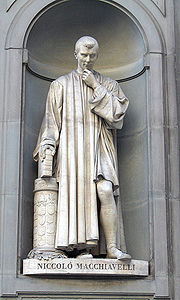
The Prince, which was written for a man named Lorenzo de Medici, is about power; how to get it and how to keep it. The methods described in the book are considered by many to be cruel and amoral, yet it is still widely read almost 500 years after it was first written.
Machiavelli’s methods did not include bucket filling. In fact, while he believed that it was best for leaders to be both loved and feared, he also believed that most people could only be one or the other. In such a case, he wrote, it was better to be feared.
Machiavelli wrote his book in a cold, purely objective tone. It contains no emotional content or sentimentality. As a result, while the book contains some good advice, it is known primarily for supporting the belief that “the end justifies the means”.
For Machiavelli, any tool (the means) used to get or keep power (the end) was okay. That’s been interpreted to include lying, cheating, bullying, backstabbing, stealing, spying and even murder. Today, such methods are called “machinations” and people who use them are called “Machiavellian”.
Some Machiavellian historical figures:

Julius Caesar.

Napoleon.

Hitler.
While frowned upon by most people, machinations are used today by people seeking to have a power advantage over others. For example, it is said that Bill Gates,

the founder of Microsoft and one of the richest people in the world, started his company with stolen software.

If you’ve been watching this season’s Survivor, then you’ve seen machinations in action, for one of the players, Russell, is Machiavellian to the extreme.

In his first couple of days on the show, he emptied everyone’s canteen, burned some of their clothes and made alliances with several players. Making alliances are a normal tactic in this game, except that Russell made the same promise to all of the them: “I’ll take you to the final two with me”. You do the math.
On the first night Russell told all of his teammates a story of how he was in New Orleans when hurricane Katrina struck, got stranded on the roof of his house in the flood that followed and lost his dog in the process. All of his teammates felt sympathy for him.
There was only one problem:
“I’ve never been to Louisiana, let alone New Orleans,” he told the cameraman.
Whenever anyone told Russell that they didn’t trust him, he arranged to have them voted off by saying the other player “wasn’t trustworthy”.
Russell’s Machiavellian strategy has gotten him to the merge and the final 10, but he is now outnumbered by the former members of another tribe. They don’t trust him.
Many historical Machiavellian leaders met unpleasant ends. Julius Caesar was murdered. Napoleon was exiled. Hitler killed himself.
Within the tiny world of Survivor, Russell strives to be Caesar. It will be interesting to see how it plays out, for it will demonstrate how effective machinations can be in the 21st century; some 5 centuries after they were first described.
Thursday, October 15, 2009
One Day in October
October 17, 1989 was a special day, for it was the occasion of the first World Series game to be played in San Francisco since 1962. To make it even more interesting, the Giants would be playing their cross bay rivals, the Oakland A's. I'd been looking forward to it for weeks.
As I walked to work through the busy streets of the city that afternoon, it seemed like every car I passed had its windows open and its radio on and that every radio was tuned to the game.
The day was hot and dry. There was absolutely no breeze. The heat had a heavy quality particular to fall. As I walked, I heard a woman say, “this feels like earthquake weather.”
We know that there is no connection between earthquakes and the weather, but on that day, that woman proved prophetic. At 5:04 that afternoon, the Loma Prieta Earthquake struck.
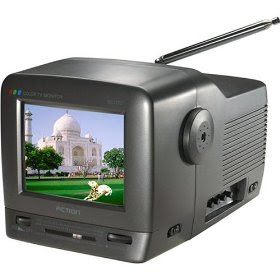
Most people will tell you that they were in the midst of their normal routine that day. I know I was. The only unusual thing I did that day was to bring a T.V. to work in order to watch the game.
In those days, I owned my own businesses.
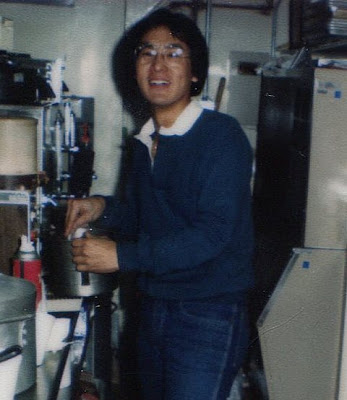
My partners and I owned three stores: two Double Rainbow Ice Cream franchises
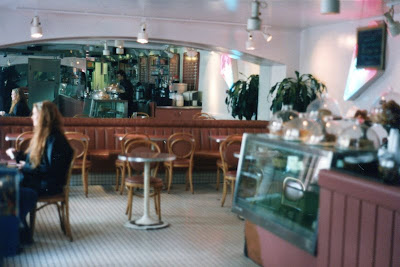

and a coffee store called Designer Beans.

That afternoon, I was working at our Double Rainbow store near Union Square in San Francisco.
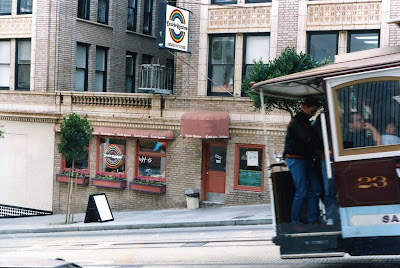
When I got to work, I put the TV behind the counter so that everyone could see it.
Just before the game started, the earthquake hit.
In the store, we felt one large jolt. A bottle of Italian soda syrup fell off a shelf.

The power went out.
Then, it was over.
I’d been through many earthquakes before, so I didn’t think much of this one. After all, We'd only lost one bottle off of a shelf lined with them.
Not everyone had the same reaction. People came streaming out of the Holiday Inn across the street. Many of them had left in a hurry. They stood, in a daze, on the sidewalk, some in bathrobes and slippers. Soon, the sidewalk was filled with people from other buildings in the neighborhood, all looking worried and confused.
Upon seeing this, one of my employees looked at me and grinned.
“Tourists,” he snickered.
Despite the power outage, the TV continued to work, because it could run on batteries, but the screen was black. No sound either. We suddenly felt cut off.
After a few minutes, TV stations went back on the air. They’d lost power too, but had switched to emergency generators in order to go back on the air.
The first pictures we saw were of fans, players, umpires and police standing together on the playing field at Candlestick Park.

The TV announcer, Al Michaels, lived in the Bay Area. He handled the situation in an calm, relaxed manner, for he too had been through many earthquakes. When the quake hit, he continued broadcasting. He simply changed the subject from baseball to earthquakes.
Johnny Bench, a Hall of Fame catcher who was doing the radio broadcast, had not been through an earthquake before. When it hit, he jumped out of his chair and ran for the nearest steel doorway. Later his broadcast partner, Jack Buck, told him, “If you moved that fast when you played, you wouldn’t have hit into so many double plays.”
Back at the store, our first indication that this earthquake was more serious than we thought was when Al Michaels announced that Candlestick Park was being evacuated due to possible damage to the structure. The channel then switched to a shot of the Bay Bridge, where one section of the roadway collapsed.
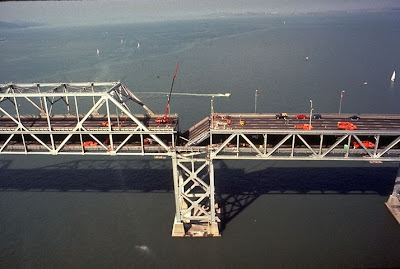
My store stayed open. We were one of the few that did. Many of the people milling around on the street came in as if to seek refuge from a storm.
We sold them ice cream, baked goods and rapidly cooling coffee. Some customers tried to hoard food by trying to buy whole loaves of banana bread or lemon cake. We had to impose a two slice per person limit.
One of my workers arrived for her 6 o’clock shift. With wide eyes, she told me that she was at her school, St. Rose Academy, when the quake hit. She was walking across the yard.
“The ground rolled across the blacktop like a wave,” she said.
Customers stayed to watch my 5” TV. It was their only source of information. Everyone crowded into one corner of the store. As it got dark outside, they stayed, attracted to the TV like moths to a flame.
At first, all we saw were shots of the Bay Bridge. Then we saw shots of collapsed or burning buildings in the Marina District.
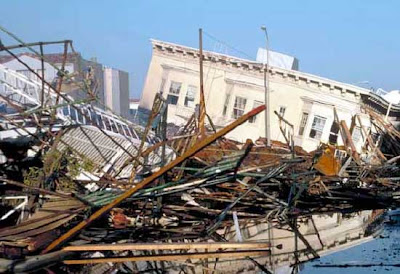
My sister lived in the Marina. I began to worry.
Then we saw a shot of a collapsed freeway in Oakland.

The crowd let out a collective gasp.
Night fell. The power remained out. Our emergency lights were on, so we stayed open just to let people watch TV.
We ran out of baked goods and coffee.
Nobody was in the mood for ice cream.
After the crowd thinned out we closed the store.
My next challenge was to get home. I lived about 20 miles away in the East Bay and used the Bay Bridge every day. That night, I had to drive through the darkened city into Marin and then over the Richmond Bridge in order to get home. All of the traffic signals were out, but traffic was surprisingly orderly. Still, it took me over an 2 hours to make what was normally a 45 minute drive.
My house had power. I turned to lights on to find my bookshelves toppled and everything that was on them scattered all over the floor. As I surveyed the damage, my cats came out from wherever they were hiding, rubbed against my leg and yowled at me as it to say, “Where the heck have you been?

The ice cream store didn’t get power back for two days. We packed the ice cream in dry ice to try to save it, but eventually had to throw out about 30 gallons of the stuff.
Game 3 of the World Series was postponed for 10 days. The A's won. They also won game 4 the following day to complete a sweep.
My sister wasn't hurt and her building sustained no damage.
The damage at St. Rose Academy was so extensive that it had to close. The building is boarded up to this day. The school eventually reopened at a new location.
As I walked to work through the busy streets of the city that afternoon, it seemed like every car I passed had its windows open and its radio on and that every radio was tuned to the game.
The day was hot and dry. There was absolutely no breeze. The heat had a heavy quality particular to fall. As I walked, I heard a woman say, “this feels like earthquake weather.”
We know that there is no connection between earthquakes and the weather, but on that day, that woman proved prophetic. At 5:04 that afternoon, the Loma Prieta Earthquake struck.
Most people will tell you that they were in the midst of their normal routine that day. I know I was. The only unusual thing I did that day was to bring a T.V. to work in order to watch the game.

In those days, I owned my own businesses.

My partners and I owned three stores: two Double Rainbow Ice Cream franchises


and a coffee store called Designer Beans.

That afternoon, I was working at our Double Rainbow store near Union Square in San Francisco.

When I got to work, I put the TV behind the counter so that everyone could see it.
Just before the game started, the earthquake hit.
In the store, we felt one large jolt. A bottle of Italian soda syrup fell off a shelf.

The power went out.
Then, it was over.
I’d been through many earthquakes before, so I didn’t think much of this one. After all, We'd only lost one bottle off of a shelf lined with them.
Not everyone had the same reaction. People came streaming out of the Holiday Inn across the street. Many of them had left in a hurry. They stood, in a daze, on the sidewalk, some in bathrobes and slippers. Soon, the sidewalk was filled with people from other buildings in the neighborhood, all looking worried and confused.
Upon seeing this, one of my employees looked at me and grinned.
“Tourists,” he snickered.
Despite the power outage, the TV continued to work, because it could run on batteries, but the screen was black. No sound either. We suddenly felt cut off.
After a few minutes, TV stations went back on the air. They’d lost power too, but had switched to emergency generators in order to go back on the air.
The first pictures we saw were of fans, players, umpires and police standing together on the playing field at Candlestick Park.

The TV announcer, Al Michaels, lived in the Bay Area. He handled the situation in an calm, relaxed manner, for he too had been through many earthquakes. When the quake hit, he continued broadcasting. He simply changed the subject from baseball to earthquakes.
Johnny Bench, a Hall of Fame catcher who was doing the radio broadcast, had not been through an earthquake before. When it hit, he jumped out of his chair and ran for the nearest steel doorway. Later his broadcast partner, Jack Buck, told him, “If you moved that fast when you played, you wouldn’t have hit into so many double plays.”
Back at the store, our first indication that this earthquake was more serious than we thought was when Al Michaels announced that Candlestick Park was being evacuated due to possible damage to the structure. The channel then switched to a shot of the Bay Bridge, where one section of the roadway collapsed.

My store stayed open. We were one of the few that did. Many of the people milling around on the street came in as if to seek refuge from a storm.
We sold them ice cream, baked goods and rapidly cooling coffee. Some customers tried to hoard food by trying to buy whole loaves of banana bread or lemon cake. We had to impose a two slice per person limit.
One of my workers arrived for her 6 o’clock shift. With wide eyes, she told me that she was at her school, St. Rose Academy, when the quake hit. She was walking across the yard.
“The ground rolled across the blacktop like a wave,” she said.
Customers stayed to watch my 5” TV. It was their only source of information. Everyone crowded into one corner of the store. As it got dark outside, they stayed, attracted to the TV like moths to a flame.
At first, all we saw were shots of the Bay Bridge. Then we saw shots of collapsed or burning buildings in the Marina District.

My sister lived in the Marina. I began to worry.
Then we saw a shot of a collapsed freeway in Oakland.

The crowd let out a collective gasp.
Night fell. The power remained out. Our emergency lights were on, so we stayed open just to let people watch TV.
We ran out of baked goods and coffee.
Nobody was in the mood for ice cream.
After the crowd thinned out we closed the store.
My next challenge was to get home. I lived about 20 miles away in the East Bay and used the Bay Bridge every day. That night, I had to drive through the darkened city into Marin and then over the Richmond Bridge in order to get home. All of the traffic signals were out, but traffic was surprisingly orderly. Still, it took me over an 2 hours to make what was normally a 45 minute drive.
My house had power. I turned to lights on to find my bookshelves toppled and everything that was on them scattered all over the floor. As I surveyed the damage, my cats came out from wherever they were hiding, rubbed against my leg and yowled at me as it to say, “Where the heck have you been?

The ice cream store didn’t get power back for two days. We packed the ice cream in dry ice to try to save it, but eventually had to throw out about 30 gallons of the stuff.
Game 3 of the World Series was postponed for 10 days. The A's won. They also won game 4 the following day to complete a sweep.
My sister wasn't hurt and her building sustained no damage.
The damage at St. Rose Academy was so extensive that it had to close. The building is boarded up to this day. The school eventually reopened at a new location.
Thursday, September 10, 2009
Sometimes, All You Have to Do Is Show UP

Jonathon Sanchez is a pitcher for the San Francisco Giants.
At the beginning of this baseball season, despite having a great arm, "nasty stuff" and being selected to play in the World Baseball Classic, Sanchez was thought to be only the 5th best starting pitcher on the Giants.
Sanchez's basic problem was that he had a way of emptying his own bucket - getting mad at himself for making a bad pitch, or worrying about how the umpire was calling balls and strikes. Sanchez often pitched well for the first few innings of his games; then something would happen to upset him and he would fall apart.
So poorly did Sanchez's pitching become that he wasn't allowed to start anymore. Instead, he was sent to the bullpen so that he could practice.
A couple of weeks after being sent to the bullpen, one of the Giants' other pitchers, Randy Johnson, got hurt. Sanchez was chosen to replace him.
Excited about his second chance and confident that the things he'd been practicing were working, Sanchez told all of his friends and family about his upcoming start. Most of his friends promised to watch the game on TV, but one decided to come to the game.
That person was Jonathon Sanchez's dad. He lives in Puerto Rico. He had never seen his son pitch in the major leagues.
When Jonathon Sanchez found out that his dad was going to be at the game, he said: "I'm really pumped up. My dad is going to be at the game."
On that night, July 10, 2009, Jonathon Sanchez threw a no-hitter.
Sometimes, just being there is enough to fill someone's bucket, and people with full buckets are capable of extraordinary things.

Wednesday, June 10, 2009
J.T. and Coach: A Contrast in Character
Anybody watch the last edition of "Survivor"?
I started watching this show a couple of years ago, mostly because a lot of my students watched it and it gave us something we could talk about together. Those students are gone now, but I still watch the show because I find it to be an interesting study of people's behavior. As I watch the show I'm always struck by how many different kinds of personalities there are and the way living under extreme conditions brings out the best and worst in them.
As one watches the show, one can't help but to start rooting for, or against, certain players. Through my conversations with others who watch the show I've learned that viewers have many different reasons for liking or disliking characters. I'm always a little surprised at how many viewers choose favorites based on how a person looks. To me, that's completely insignificant. My favorite players are the ones who exhibit the strongest character.
By strongest character, I mean the players who possess personality traits such as trustworthiness, reliability, ingenuity, willingness to work hard, cooperation and leadership ability and who are able to exhibit these characteristics even under the most extreme circumstances.
Last season, there were two contestants who offered a sharp contrasts in character. One of them talked about the value of character, but didn't practice it, while the other practiced it, but didn't talk about it.
In one of his interviews early in the show, "Coach", as he wanted to be known, told viewers that he wanted to play the game "with honesty and integrity".
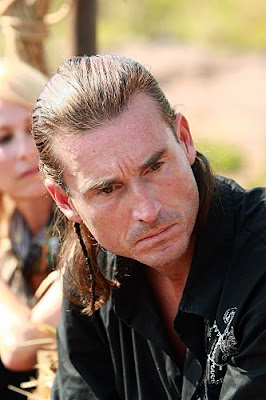
As the game went on, he called his allies "warriors" and himself the "dragonslayer". He would tell the other players stories of life and death experiences which he barely survived.
At other times, he would wander off by himself (but in full view of the other players) and engage in a martial arts/meditation routine that "only about 20 people in the world know about". Maybe, but it looked pretty hokey.
Other players weren't impressed.
"A 37 year old man who calls himself the Dragonslayer? Give me a break". said one (for that matter, why does a grown man want to known as "Coach"?.
Coach's behavior was designed to do two things: a) draw attention to himself and b) convince the world that he had experience that few others had and that it made him somehow better than everybody else. The "honor and integrity" line was just something he said to make himself look good.
Later in the show, Coach's true nature was revealed. When it was clear that he was losing his grip on the game, Coach suddenly changed his tune. On a day when it seemed like there was a chance that he would be sent to "Exile Island", where he would have to spend the night alone with no fire and no food, he pleaded not to be sent, saying that he had "asthma".
"Asthma?," asked another player, "we've been here 30 something days and that's the first time he's mentioned asthma. I think he's scared to go to exile."
They sent him anyway.
Later, in an immunity challenge requiring a great deal of mental toughness to win, Coach, the dragonslayer and martial arts practitioner, eliminated himself by collapsing onto the ground and curling himself into a ball. He claimed that his back hurt.
The dragonslayer had gone from mysterious and arrogant to just plain pathetic.
In almost direct contrast to Coach was J.T..

While Coach tried to create this mystical air about himself, J.T. described himself as a "just a Farm boy from Alabama". While Coach was "meditating", J.T. was fishing for the whole team or chopping wood or cooking. While Coach was telling stories about his wild "experiences", J.T. just listened, never talking about himself. When all of the contestants were asked "who would you trust with your life?", the unanimous choice was J.T.. When it obvious that it was time to vote Coach out of the game, the only player who didn't vote for him was J.T., because he once promised Coach that he would never vote against him. For all of Coach's talk about playing the game with honor and integrity, it was J.T. who actually did it.
In the end, J.T. became only the second unanimous winner in Survivor history.
Character counts.
Addendum: Honor and integrity? After the show was over, it was revealed that Coach isn't one. That's because he was fired from his job for lying. Apparently, he told the college for which he worked that he needed a leave of absence for "cancer tests". He actually left to play Survivor.
Somebody researched Coach's stories by matching his claimed dates and events to real events and the same times and locations. They didn't match.
Finally, somebody asked Coach where he learned his "meditation" routine. In a rare moment of honesty, he said he made it up for the show.

I started watching this show a couple of years ago, mostly because a lot of my students watched it and it gave us something we could talk about together. Those students are gone now, but I still watch the show because I find it to be an interesting study of people's behavior. As I watch the show I'm always struck by how many different kinds of personalities there are and the way living under extreme conditions brings out the best and worst in them.
As one watches the show, one can't help but to start rooting for, or against, certain players. Through my conversations with others who watch the show I've learned that viewers have many different reasons for liking or disliking characters. I'm always a little surprised at how many viewers choose favorites based on how a person looks. To me, that's completely insignificant. My favorite players are the ones who exhibit the strongest character.
By strongest character, I mean the players who possess personality traits such as trustworthiness, reliability, ingenuity, willingness to work hard, cooperation and leadership ability and who are able to exhibit these characteristics even under the most extreme circumstances.
Last season, there were two contestants who offered a sharp contrasts in character. One of them talked about the value of character, but didn't practice it, while the other practiced it, but didn't talk about it.
In one of his interviews early in the show, "Coach", as he wanted to be known, told viewers that he wanted to play the game "with honesty and integrity".

As the game went on, he called his allies "warriors" and himself the "dragonslayer". He would tell the other players stories of life and death experiences which he barely survived.
At other times, he would wander off by himself (but in full view of the other players) and engage in a martial arts/meditation routine that "only about 20 people in the world know about". Maybe, but it looked pretty hokey.
Other players weren't impressed.
"A 37 year old man who calls himself the Dragonslayer? Give me a break". said one (for that matter, why does a grown man want to known as "Coach"?.
Coach's behavior was designed to do two things: a) draw attention to himself and b) convince the world that he had experience that few others had and that it made him somehow better than everybody else. The "honor and integrity" line was just something he said to make himself look good.
Later in the show, Coach's true nature was revealed. When it was clear that he was losing his grip on the game, Coach suddenly changed his tune. On a day when it seemed like there was a chance that he would be sent to "Exile Island", where he would have to spend the night alone with no fire and no food, he pleaded not to be sent, saying that he had "asthma".
"Asthma?," asked another player, "we've been here 30 something days and that's the first time he's mentioned asthma. I think he's scared to go to exile."
They sent him anyway.
Later, in an immunity challenge requiring a great deal of mental toughness to win, Coach, the dragonslayer and martial arts practitioner, eliminated himself by collapsing onto the ground and curling himself into a ball. He claimed that his back hurt.
The dragonslayer had gone from mysterious and arrogant to just plain pathetic.
In almost direct contrast to Coach was J.T..

While Coach tried to create this mystical air about himself, J.T. described himself as a "just a Farm boy from Alabama". While Coach was "meditating", J.T. was fishing for the whole team or chopping wood or cooking. While Coach was telling stories about his wild "experiences", J.T. just listened, never talking about himself. When all of the contestants were asked "who would you trust with your life?", the unanimous choice was J.T.. When it obvious that it was time to vote Coach out of the game, the only player who didn't vote for him was J.T., because he once promised Coach that he would never vote against him. For all of Coach's talk about playing the game with honor and integrity, it was J.T. who actually did it.
In the end, J.T. became only the second unanimous winner in Survivor history.
Character counts.
Addendum: Honor and integrity? After the show was over, it was revealed that Coach isn't one. That's because he was fired from his job for lying. Apparently, he told the college for which he worked that he needed a leave of absence for "cancer tests". He actually left to play Survivor.
Somebody researched Coach's stories by matching his claimed dates and events to real events and the same times and locations. They didn't match.
Finally, somebody asked Coach where he learned his "meditation" routine. In a rare moment of honesty, he said he made it up for the show.
Saturday, May 16, 2009
The Power of Determination and Persistance
Graduation speeches are an old tradition. All of you will speak at your 5th grade graduation, but as you get older and your schools get bigger, fewer and fewer graduating students get to speak. At big Universities, famous people are asked to speak.
President Obama will be speaking at University of Notre Dame, one of the most famous schools in the country. Notre Dame has 8000 students.
Michelle Obama spoke to the first graduating class of UC Merced, a school that's only been in existence for 4 years and which has only 2718 students.
Why did Mrs. Obama choose to speak at this small school? Read on...
First Lady Delivers a Charge to Graduates
Jim Wilson/The New York Times
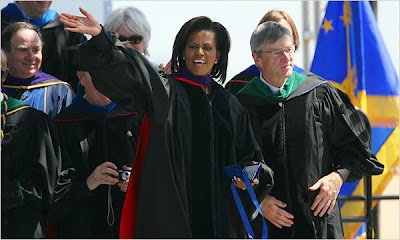
First Lady Michelle Obama waves to the first full four year graduates of the Univ of California at Merced on Saturday.
Published: May 16, 2009
MERCED, Calif. — Michelle Obama on Saturday encouraged the first full graduating class at the University of California, Merced, to help change the world by using the same determination they had shown in bringing her to campus.
“A few people may be wondering why did I choose the University of California, Merced, to deliver my first commencement speech as first lady,” Mrs. Obama said. “The answer is simple: you inspired me, you touched me.
“There are few things that are more rewarding than to watch young people recognize that they have the power to make their dreams come true. And you did just that.”
Mrs. Obama was drafted to speak here at the smallest, newest campus in the University of California system through a lobbying effort by students and their families. They peppered the White House with letters, videos and hundreds of Valentine’s Day cards.
“And let me tell you, it worked,” she said. “Because I’m here.”
The speech capped weeks of anticipation at the university for an event that left some students star-struck on a blazingly bright and hot afternoon.
“I haven’t seen anyone of that magnitude in person,” said Daniel Titcher, 22, a senior. “Maybe a state senator or assemblyman or something, but nothing like this.”
The appearance also delighted university officials, who had been working to raise enough money to pay for a more elaborate commencement, attended by more than 10,000 people. The $700,000 price tag for the event included enhanced security, like dozens of metal detectors. Lookouts were on rooftops around the school’s quad, and Secret Service agents patrolled the campus, which sits surrounded by browning farmland outside Merced.
John Garamendi Jr., the vice chancellor for university relations, said he had been supportive but skeptical when student leaders told him they were trying to book Mrs. Obama. “I said, ‘Good luck,’ ” Mr. Garamendi recalled, with a laugh. “I said, ‘I love you guys.’ And I kept walking.”
But sure enough, in late March, Mrs. Obama announced that she would make her sole college commencement appearance this season at the Merced campus. The decision brought a swell of pride to this university in the Central Valley of California.
“Anybody who asks where my daughter’s graduating from, I say, ‘U.C. Merced,’ and they go, ‘Oh!’ ” said Shelly Comer, a nurse whose elder daughter, Michelle, was receiving her degree in psychology. “And then they start talking about Michelle Obama.”
Mr. Garamendi echoed that. “The eyes of the world are on us at this moment,” he said. “People are learning that there are positive things happening in California’s Central Valley.”
The first lady’s visit brought a jolt of excitement to the region, which has been battered by drought, high unemployment and a high foreclosure rate.
Conor Mangan, 22, said he hoped that Mrs. Obama’s appearance would help the local economy, if only for a day. “I hope it pays off,” said Mr. Mangan, who noted that he had backed Ron Paul in the presidential race.
Economic concerns were also on the mind of Irvin Junprung, 22, a biology major, who summed up the immediate plans for him and many of his fellow graduates. “Find work,” Mr. Junprung said.
Speaking at the commencement, Mrs. Obama stayed on inspirational terrain, echoing President Obama’s themes of community service and perseverance in tough times. “My husband knows a little something about the power of hope,” she said. “You are the hope of Merced. And this nation.”
President Obama will be speaking at University of Notre Dame, one of the most famous schools in the country. Notre Dame has 8000 students.
Michelle Obama spoke to the first graduating class of UC Merced, a school that's only been in existence for 4 years and which has only 2718 students.
Why did Mrs. Obama choose to speak at this small school? Read on...
First Lady Delivers a Charge to Graduates
Jim Wilson/The New York Times

First Lady Michelle Obama waves to the first full four year graduates of the Univ of California at Merced on Saturday.
Published: May 16, 2009
MERCED, Calif. — Michelle Obama on Saturday encouraged the first full graduating class at the University of California, Merced, to help change the world by using the same determination they had shown in bringing her to campus.
“A few people may be wondering why did I choose the University of California, Merced, to deliver my first commencement speech as first lady,” Mrs. Obama said. “The answer is simple: you inspired me, you touched me.
“There are few things that are more rewarding than to watch young people recognize that they have the power to make their dreams come true. And you did just that.”
Mrs. Obama was drafted to speak here at the smallest, newest campus in the University of California system through a lobbying effort by students and their families. They peppered the White House with letters, videos and hundreds of Valentine’s Day cards.
“And let me tell you, it worked,” she said. “Because I’m here.”
The speech capped weeks of anticipation at the university for an event that left some students star-struck on a blazingly bright and hot afternoon.
“I haven’t seen anyone of that magnitude in person,” said Daniel Titcher, 22, a senior. “Maybe a state senator or assemblyman or something, but nothing like this.”
The appearance also delighted university officials, who had been working to raise enough money to pay for a more elaborate commencement, attended by more than 10,000 people. The $700,000 price tag for the event included enhanced security, like dozens of metal detectors. Lookouts were on rooftops around the school’s quad, and Secret Service agents patrolled the campus, which sits surrounded by browning farmland outside Merced.
John Garamendi Jr., the vice chancellor for university relations, said he had been supportive but skeptical when student leaders told him they were trying to book Mrs. Obama. “I said, ‘Good luck,’ ” Mr. Garamendi recalled, with a laugh. “I said, ‘I love you guys.’ And I kept walking.”
But sure enough, in late March, Mrs. Obama announced that she would make her sole college commencement appearance this season at the Merced campus. The decision brought a swell of pride to this university in the Central Valley of California.
“Anybody who asks where my daughter’s graduating from, I say, ‘U.C. Merced,’ and they go, ‘Oh!’ ” said Shelly Comer, a nurse whose elder daughter, Michelle, was receiving her degree in psychology. “And then they start talking about Michelle Obama.”
Mr. Garamendi echoed that. “The eyes of the world are on us at this moment,” he said. “People are learning that there are positive things happening in California’s Central Valley.”
The first lady’s visit brought a jolt of excitement to the region, which has been battered by drought, high unemployment and a high foreclosure rate.
Conor Mangan, 22, said he hoped that Mrs. Obama’s appearance would help the local economy, if only for a day. “I hope it pays off,” said Mr. Mangan, who noted that he had backed Ron Paul in the presidential race.
Economic concerns were also on the mind of Irvin Junprung, 22, a biology major, who summed up the immediate plans for him and many of his fellow graduates. “Find work,” Mr. Junprung said.
Speaking at the commencement, Mrs. Obama stayed on inspirational terrain, echoing President Obama’s themes of community service and perseverance in tough times. “My husband knows a little something about the power of hope,” she said. “You are the hope of Merced. And this nation.”
Thursday, April 2, 2009
The Curious Case of Sidd Finch

He's a pitcher, part yogi and part recluse. Impressively liberated from our opulent life-style, Sidd's deciding about yoga -- and his future in baseball
By George Plimpton
The secret cannot be kept much longer. Questions are being asked, and sooner rather than later the New York Mets management will have to produce a statement. It may have started unraveling in St. Petersburg, Fla. two weeks ago, on March 14, to be exact, when Mel Stottlemyre, the Met pitching coach, walked over to the 40-odd Met players doing their morning calisthenics at the Payson Field Complex not far from the Gulf of Mexico, a solitary figure among the pulsation of jumping jacks, and motioned three Mets to step out of the exercise. The three, all good prospects, were John Christensen, a 24-year-old outfielder; Dave Cochrane, a spare but muscular switch-hitting third baseman; and Lenny Dykstra, a swift centerfielder who may be the Mets' lead-off man of the future.
Ordering the three to collect their bats and batting helmets, Stottlemyre led the players to the north end of the complex where a large canvas enclosure had been constructed two weeks before. The rumor was that some irrigation machinery was being installed in an underground pit.
Standing outside the enclosure, Stottlemyre explained what he wanted. "First of all," the coach said, "the club's got kind of a delicate situation here, and it would help if you kept reasonably quiet about it. O.K.?" The three nodded. Stottlemyre said, "We've got a young pitcher we're looking at. We want to see what he'll do with a batter standing in the box. We'll do this alphabetically. John, go on in there, stand at the plate and give the pitcher a target. That's all you have to do."
"Do you want me to take a cut?" Christensen asked.
Stottlemyre produced a dry chuckle. "You can do anything you want."
Christensen pulled aside a canvas flap and found himself inside a rectangular area about 90 feet long and 30 feet wide, open to the sky, with a home plate set in the ground just in front of him, and down at the far end a pitcher's mound, with a small group of Met front-office personnel standing behind it, facing home plate. Christensen recognized Nelson Doubleday, the owner of the Mets, and Frank Cashen, wearing a long-billed fishing cap. He had never seen Doubleday at the training facility before.
Christensen bats righthanded. As he stepped around the plate he nodded to Ronn Reynolds, the stocky reserve catcher who has been with the Met organization since 1980. Reynolds whispered up to him from his crouch, "Kid, you won't believe what you're about to see."
A second flap down by the pitcher's end was drawn open, and a tall, gawky player walked in and stepped up onto the pitcher's mound. He was wearing a small, black fielder's glove on his left hand and was holding a baseball in his right. Christensen had never seen him before. He had blue eyes, Christensen remembers, and a pale, youthful face, with facial muscles that were motionless, like a mask. "You notice it," Christensen explained later, "when a pitcher's jaw isn't working on a chaw or a piece of gum." Then to Christensen's astonishment he saw that the pitcher, pawing at the dirt of the mound to get it smoothed out properly and to his liking, was wearing a heavy hiking boot on his right foot.
Christensen has since been persuaded to describe that first confrontation:
"I'm standing in there to give this guy a target, just waving the bat once or twice out over the plate. He starts his windup. He sways way back, like Juan Marichal, this hiking boot comes clomping over -- I thought maybe he was wearing it for balance or something -- and he suddenly rears upright like a catapult. The ball is launched from an arm completely straight up and stiff. Before you can blink, the ball is in the catcher's mitt. You hear it crack, and then there's this little bleat from Reynolds."
Christensen said the motion reminded him of the extraordinary contortions that he remembered of Goofy's pitching in one of Walt Disney's cartoon classics.
"I never dreamed a baseball could be thrown that fast. The wrist must have a lot to do with it, and all that leverage. You can hardly see the blur of it as it goes by. As for hitting the thing, frankly, I just don't think it's humanly possible. You could send a blind man up there, and maybe he'd do better hitting at the sound of the thing."
Christensen's opinion was echoed by both Cochrane and Dykstra, who followed him into the enclosure. When each had done his stint, he emerged startled and awestruck.
Especially Dykstra. Offering a comparison for SI, he reported that out of curiosity he had once turned up the dials that control the motors of the pitching machine to maximum velocity, thus producing a pitch that went approximately 106 miles per hour. "What I looked at in there," he said, motioning toward the enclosure, "was whistling by another third as fast, I swear."
The phenomenon the three young batters faced, and about whom only Reynolds, Stottlemyre and a few members of the Mets' front office know, is a 28-year-old, somewhat eccentric mystic named Hayden (Sidd) Finch. He may well change the course of baseball history. On St. Patrick's Day, to make sure they were not all victims of a crazy hallucination, the Mets brought in a radar gun to measure the speed of Finch's fastball. The model used was a JUGS Supergun II. It looks like a black space gun with a big snout, weighs about five pounds and is usually pointed at the pitcher from behind the catcher. A glass plate in the back of the gun shows the pitch's velocity -- accurate, so the manufacturer claims, to within plus or minus 1 mph. The figure at the top of the gauge is 200 mph. The fastest projectile ever measured by the JUGS (which is named after the oldtimer's descriptive -- the "jug-handled" curveball) was a Roscoe Tanner serve that registered 153 mph. The highest number that the JUGS had ever turned for a baseball was 103 mph, which it did, curiously, twice on one day, July 11, at the 1978 All-Star game when both Goose Gossage and Nolan Ryan threw the ball at that speed. On March 17, the gun was handled by Stottlemyre. He heard the pop of the ball in Reynolds's mitt and the little squeak of pain from the catcher. Then the astonishing figure 168 appeared on the glass plate. Stottlemyre remembers whistling in amazement, and then he heard Reynolds say, "Don't tell me, Mel, I don't want to know. . . "
This article was originally published in 1985. To figure out what this is really about, write down the first letter or each word in the subtitle. It is one of the most famous pranks of all time...
Sunday, March 8, 2009
The Power of One
At number 2 on the list of the greatest athletes ever to play at the U. C. Berkeley (Cal) is Joe Kapp.

Joe Kapp was a football player. He is a member of the College Football Hall of Fame. One of his coaches, John Ralston, once said that Kapp was the only player he'd ever seen that could start at all 22 positions for his team. As starting quarterback, he lead the Cal Bears to a Rose Bowl, won a Canadian Football League Championship with the British Columbia Lions and lead the Minnesota Vikings to a Super Bowl.
While with the Vikings, he once threw seven touchdown passes in one game, a National Football League record.
Kapp was a great leader. He is known for catchy motivational sayings like "40 for 60" (40 players playing hard for 60 minutes) and "the Bear does not quit, the Bear does not die." (after a miraculous last second Cal win over Stanford in the 1982 Big Game).
He was also very tough. Most quarterbacks try to avoid getting tackled as much as possible. Kapp didn't. Instead, he would try to run over defensive players in order to gain a couple extra yards.
During one game he was asked why he hit an opposing player instead of running out of bounds. Kapp replied, "running out of bounds is for white boys." Joe Kapp is hispanic.
Kapp's stardom never went to his head. He once refused an MVP award because he didn't believe individual awards. He was always a great teammate no matter what the sport. In fact, this story is not about football at all, but how Joe Kapp won a basketball game without playing a single minute.
While at Cal, Kapp played both football and basketball. He wasn't a very good basketball player. In fact, he was, in his own words, "the 12th player on a 12 man team", meaning he rarely got to play. The Cal team, however, was very good.
One of Cal's best players was guy named Earl Robinson.

In 1958, Robinson was one of the few African Americans to be awarded an athletic scholarship at a major American university. In those days, many opposing teams and players were unable to accept this.
During one game, opposing players decided to pick on Robinson. They pushed him, elbowed him and threw racial taunts at him.
Kapp watched this from the bench and fumed. The taunting seemed to affect the whole Cal team. When the first half ended, Cal was far behind.
When the Cal team met in the locker room between halves, Joe Kapp was nowhere to be seen. He had gone to the opposing team's locker room instead.
There, he told the opposing players that he was sick of watching how they were treating Robinson. "Now you have to deal with me," he said, challenging the whole team to a fight, "who wants to go first?"
Nobody answered. In fact, nobody would make eye contact.
When the two teams went back into the gym to warm up for the second half, Kapp didn't shoot around with his teammates. Instead, he stood with arms crossed, glaring at the other team.
Kapp's actions fired up the Cal team. They played the second half with great intensity, came back and won the game.
Afterwards, a reporter asked the Cal coach (the late, great Pete Newell) what he said to motivate the team.

"I didn't have to say anything," said Newell, "Joe Kapp did all of our talking for us."

Joe Kapp was a football player. He is a member of the College Football Hall of Fame. One of his coaches, John Ralston, once said that Kapp was the only player he'd ever seen that could start at all 22 positions for his team. As starting quarterback, he lead the Cal Bears to a Rose Bowl, won a Canadian Football League Championship with the British Columbia Lions and lead the Minnesota Vikings to a Super Bowl.
While with the Vikings, he once threw seven touchdown passes in one game, a National Football League record.
Kapp was a great leader. He is known for catchy motivational sayings like "40 for 60" (40 players playing hard for 60 minutes) and "the Bear does not quit, the Bear does not die." (after a miraculous last second Cal win over Stanford in the 1982 Big Game).
He was also very tough. Most quarterbacks try to avoid getting tackled as much as possible. Kapp didn't. Instead, he would try to run over defensive players in order to gain a couple extra yards.
During one game he was asked why he hit an opposing player instead of running out of bounds. Kapp replied, "running out of bounds is for white boys." Joe Kapp is hispanic.
Kapp's stardom never went to his head. He once refused an MVP award because he didn't believe individual awards. He was always a great teammate no matter what the sport. In fact, this story is not about football at all, but how Joe Kapp won a basketball game without playing a single minute.
While at Cal, Kapp played both football and basketball. He wasn't a very good basketball player. In fact, he was, in his own words, "the 12th player on a 12 man team", meaning he rarely got to play. The Cal team, however, was very good.
One of Cal's best players was guy named Earl Robinson.

In 1958, Robinson was one of the few African Americans to be awarded an athletic scholarship at a major American university. In those days, many opposing teams and players were unable to accept this.
During one game, opposing players decided to pick on Robinson. They pushed him, elbowed him and threw racial taunts at him.
Kapp watched this from the bench and fumed. The taunting seemed to affect the whole Cal team. When the first half ended, Cal was far behind.
When the Cal team met in the locker room between halves, Joe Kapp was nowhere to be seen. He had gone to the opposing team's locker room instead.
There, he told the opposing players that he was sick of watching how they were treating Robinson. "Now you have to deal with me," he said, challenging the whole team to a fight, "who wants to go first?"
Nobody answered. In fact, nobody would make eye contact.
When the two teams went back into the gym to warm up for the second half, Kapp didn't shoot around with his teammates. Instead, he stood with arms crossed, glaring at the other team.
Kapp's actions fired up the Cal team. They played the second half with great intensity, came back and won the game.
Afterwards, a reporter asked the Cal coach (the late, great Pete Newell) what he said to motivate the team.

"I didn't have to say anything," said Newell, "Joe Kapp did all of our talking for us."
Wednesday, January 21, 2009
The Spirit of Service

One of the things I like best about President Obama is that he means what he says. Many politicians will say things or change their position on issues simply to get votes. Obama isn't like that. Obama displays a personal characteristic common to the greatest of leaders: integrity.
Obama won the election by promising the average American that they would have a voice and a role in his government. To see how effective this message was, all one had to do was turn on the television on Tuesday morning and look at the huge crowd that turned out for his inauguration.

It is said that 3 million people visited Washington DC for this event. Many had no tickets and no place to stay. Some people drove 90 hours just to be there.
In his speech, Obama constantly emphasized his belief in a government "Of the people, by the people, for the people". He did this in a subtle but significant way. Instead of a speech full of the word "I", he used the word "we". In fact, in his speech, Obama used the word "we" 61 times.
Obama's speech was also full of words like "responsibility", "honesty", "loyalty", "humility" and "generosity". These are all traits of persons of strong character. By mentioning these traits, President Obama was telling us how important they were and asked us to develop them, in ourselves and in others. If we can, once again, became a nation of strong character, Obama says, America can regain the worldwide respect it once had, and once again set an example for the world to follow.
One of the ways to accomplish this is through what the president calls "the spirit of service". It was this spirit, the idea of doing or creating something for the good of all mankind, that made America great. Instead of going through life thinking only of ourselves, Obama asks that we reach out and volunteer to help others succeed.
Obama's first call for volunteer service took place before he took office. He asked the nation to turn Martin Luther King day into a day of service. People responded in overwhelming numbers. War veterans who turned up for food drives were so surprised at the number of volunteers who showed to help that they wept. This is one small example of the power of the people.
Volunteer organizations that help our communities, nation and world can be seen everywhere.
The Peace Corps,

Americorps,

Greenpeace,

Boy Scouts

Girl Scouts,

CYO

and our PTA

are all staffed with volunteers. Without volunteers, the United States might not even exist, for the soldiers who fought for America's freedom during the Revolutionary War were all volunteers.

At Park School, we encourage the spirit of service, too. By volunteering for, and serving on, Green Team, Student Council or as a Peaceful Playgrounds Coach,

you are helping make Park School a great place to be. Your contributions as volunteers are very valuable to the school and can be very personally rewarding. We hope that your experience as a volunteer at Park will encourage you to volunteer for good causes for the rest of your life. This will make our community, our nation and the world a better place.
Wednesday, December 17, 2008
The View from the Saddle
A few weeks ago while riding my bike up the Corte Madera grade, a deer casually walked out of the woods, stopped by the side of the road, watched me ride by, then, I kid you not, looked the other way before walking across the street.

I chuckled to myself about this human-like behavior then got to thinking about all of the unusual sights I've seen while riding my bike.
First, the animals. I've seen many deer and the occasional racoon, which usually flee when they hear me coming. The turkeys, however, do not. They aren't afraid of cyclists. Problem is they travel in groups. They'll move out of one's way, but take their sweet time doing so. I've nearly hit turkeys several times, which can be pretty scary when you're going downhill at 30 miles per hour.
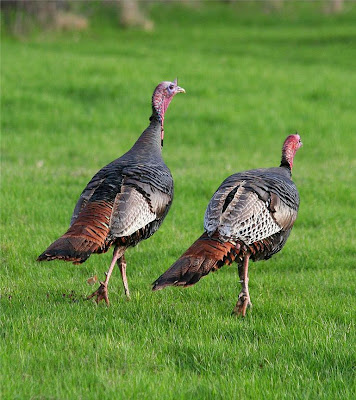
By the way: do you know that the term for a group of turkeys is "rafter" or "gang"? Gang seems especially appropriate for the turkeys around here - they walk around like they own the place.
On the stretch of Shoreline Highway between Muir Beach and the Panoramic Highway junction, I often see Red Tailed Hawks, Owls and other predatory birds roosting on the utility lines or soaring above the valley.

Very cool, especially during the spring, when you can see lots of young Red Tails learning to fly and hunt.
Most unusual animal sightings were the Bobcat, which bolted into the woods after I startled it, and the red fox which darted across the road in front of me. The fox sighting was so unexpected that I googled them when I got home. As I suspected, this is not a native species. Was I seeing things? Then, a couple of weeks later, I saw it again.

Unmistakeably a red fox. So, how did it get here?
Ridgecrest Boulevard between Rock Springs and Bolinas-Fairfax road on Mt Tam is a very popular spot for filming car commercials. While on my rides, I've stumbled upon film crews three times; once while filming a Dodge Magnum commercial and twice for different Acura models, the RDX and the TSX
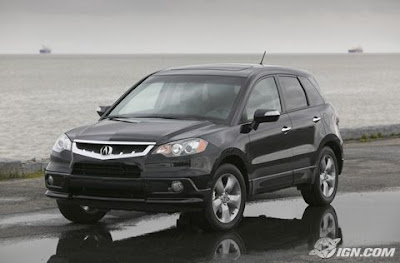
I also see a lot of cars and car clubs that are just out for fun. The roads I chose to ride are hilly and winding. Good workout going up, a blast coming down. Very little car normal car traffic, but lots of cars whose drivers are attracted to the thrill of driving twisting roads.
Among the cars I've seen are a rare Delorean, which you may recognize from the "Back to the Future" movies. This was a weird car built in Ireland with the engine in the middle, not the front, butterfly doors which open upward like wings and an unpainted body made of stainless steel.
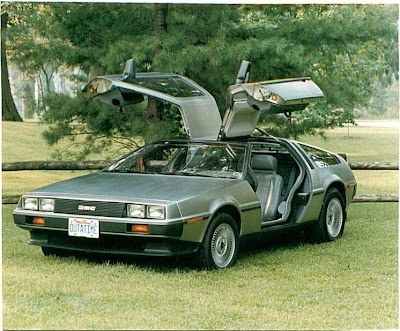
I saw a group of five climbing the road above Alpine Lake.
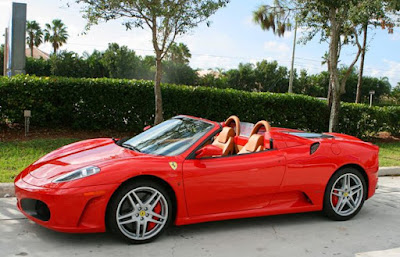
Another time a metallic blue Ferrari F40 came screaming down the road in the opposite direction. I heard this car long before I saw it.
As it passed me, I got a good look at the driver. It was multiple Olympic gold medalist Michael Johnson, who lived in Tiburon at the time.
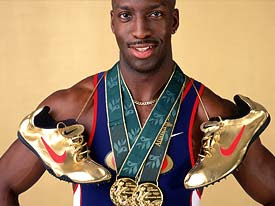
Makes sense that fast runners like fast cars.
Once, a racy looking red car that I'd never seen before passed me just outside of Mill Valley.
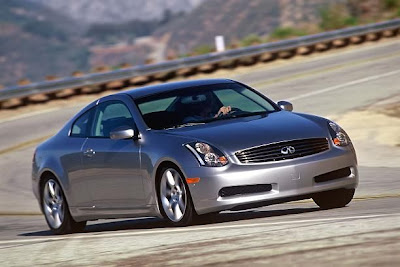
It turned out to be an Infiniti G35 coupe, which had not yet been released for sale. It was being road tested by Car & Driver magazine. I later saw the article, along with photos unmistakeably taken in Marin, in which the writer described the test route "on Highway One, north of San Francisco".
One of the first cars that allowed its buyers to customize the way it looked with special paint, wheels and stripes was the Mini Cooper. In order to advertise this and to show the car off before making available for sale, Mini got a group of drivers to go on a coast to coast tour. I encountered this tour, 18 Minis, all customized differently, between Muir and Stinson beaches.

The most memorable and unusual car encounter I had was in 2004, when Lamborghini, an Italian manufacturer of "supercars" introduced a new model called the Gallardo. The Gallardo sells for a mere $200,000, or about the same as 20 Honda Civics. To celebrate the introduction of the Gallardo, and the 40th birthday of the company, Lamborghini invited all Lamborghini owners in the Bay Area to join a couple of Gallardos for a drive. 128 Lamborghinis showed up.

They passed me on the road between Olema and Point Reyes. Loud, beautiful, fast.
Finally, there are the unusual people I've encountered. There was the guy celebrating his 70th birthday, blowing past me on the way up Mt. Tam, and the guy, bombing down the mountain, screaming "YEE HAAAA!", a camera phone taped to his helmet.

Then there were the skateboaders. I encountered three skateboarders racing down a long downhill near Alpine Lake at about 25 miles per hour.
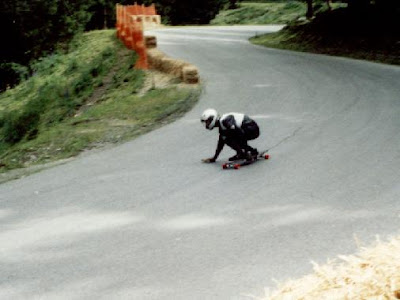
As I pulled alongside one of them, he glanced at me and said, "What's up dude?"

I chuckled to myself about this human-like behavior then got to thinking about all of the unusual sights I've seen while riding my bike.
First, the animals. I've seen many deer and the occasional racoon, which usually flee when they hear me coming. The turkeys, however, do not. They aren't afraid of cyclists. Problem is they travel in groups. They'll move out of one's way, but take their sweet time doing so. I've nearly hit turkeys several times, which can be pretty scary when you're going downhill at 30 miles per hour.

By the way: do you know that the term for a group of turkeys is "rafter" or "gang"? Gang seems especially appropriate for the turkeys around here - they walk around like they own the place.
On the stretch of Shoreline Highway between Muir Beach and the Panoramic Highway junction, I often see Red Tailed Hawks, Owls and other predatory birds roosting on the utility lines or soaring above the valley.

Very cool, especially during the spring, when you can see lots of young Red Tails learning to fly and hunt.
Most unusual animal sightings were the Bobcat, which bolted into the woods after I startled it, and the red fox which darted across the road in front of me. The fox sighting was so unexpected that I googled them when I got home. As I suspected, this is not a native species. Was I seeing things? Then, a couple of weeks later, I saw it again.

Unmistakeably a red fox. So, how did it get here?
Ridgecrest Boulevard between Rock Springs and Bolinas-Fairfax road on Mt Tam is a very popular spot for filming car commercials. While on my rides, I've stumbled upon film crews three times; once while filming a Dodge Magnum commercial and twice for different Acura models, the RDX and the TSX

I also see a lot of cars and car clubs that are just out for fun. The roads I chose to ride are hilly and winding. Good workout going up, a blast coming down. Very little car normal car traffic, but lots of cars whose drivers are attracted to the thrill of driving twisting roads.
Among the cars I've seen are a rare Delorean, which you may recognize from the "Back to the Future" movies. This was a weird car built in Ireland with the engine in the middle, not the front, butterfly doors which open upward like wings and an unpainted body made of stainless steel.

I saw a group of five climbing the road above Alpine Lake.
Another time a metallic blue Ferrari F40 came screaming down the road in the opposite direction. I heard this car long before I saw it.

As it passed me, I got a good look at the driver. It was multiple Olympic gold medalist Michael Johnson, who lived in Tiburon at the time.

Makes sense that fast runners like fast cars.
Once, a racy looking red car that I'd never seen before passed me just outside of Mill Valley.

It turned out to be an Infiniti G35 coupe, which had not yet been released for sale. It was being road tested by Car & Driver magazine. I later saw the article, along with photos unmistakeably taken in Marin, in which the writer described the test route "on Highway One, north of San Francisco".
One of the first cars that allowed its buyers to customize the way it looked with special paint, wheels and stripes was the Mini Cooper. In order to advertise this and to show the car off before making available for sale, Mini got a group of drivers to go on a coast to coast tour. I encountered this tour, 18 Minis, all customized differently, between Muir and Stinson beaches.

The most memorable and unusual car encounter I had was in 2004, when Lamborghini, an Italian manufacturer of "supercars" introduced a new model called the Gallardo. The Gallardo sells for a mere $200,000, or about the same as 20 Honda Civics. To celebrate the introduction of the Gallardo, and the 40th birthday of the company, Lamborghini invited all Lamborghini owners in the Bay Area to join a couple of Gallardos for a drive. 128 Lamborghinis showed up.

They passed me on the road between Olema and Point Reyes. Loud, beautiful, fast.
Finally, there are the unusual people I've encountered. There was the guy celebrating his 70th birthday, blowing past me on the way up Mt. Tam, and the guy, bombing down the mountain, screaming "YEE HAAAA!", a camera phone taped to his helmet.

Then there were the skateboaders. I encountered three skateboarders racing down a long downhill near Alpine Lake at about 25 miles per hour.

As I pulled alongside one of them, he glanced at me and said, "What's up dude?"
Subscribe to:
Posts (Atom)


