Friday, January 1, 2010

Backlash

back⋅lash [bak-lash] Noun: a strong or violent reaction, as to some social or political change: “a backlash of angry feeling among Southern conservatives within the party.”

In previous posts, I described what it means to be Machiavellian and how Russell Hantz used such a strategy in his attempt to win the TV show “Survivor, Samoa”.


I also wrote that machinations could only be effective to a certain point; the point to which all other participants were willing to play along.

Russell’s machinations included lying, cheating, and stealing. He lied about his personal background to win sympathy from his tribemates and he lied by creating false alliances with almost every other player in the game. A true alliance is meant to make all allies stronger. Russell’s “alliances” were really only designed to make Russell’s position stronger, for he never helped anyone and if any of his “allies” did something he didn’t like, he’s make up a story about how they weren’t trustworthy and should be voted out. The rest of the group usually went along with him.

As the game unfolded it was clear that Russell was the most dominant player in the game. From the merge to the final three, Russell controlled every aspect of the game. His Machiavellian strategy had enabled him to achieve and keep his power position.

Now here’s the trick: while a Machiavellian strategy will work to put one in power and will help one maintain a power, it creates a lot of ill will. People who use such strategy often become hated. Once they become hated others look for ways to take away their power. This is backlash.

Julius Caesar was the commander of Rome’s most powerful army. He used it to start a Roman civil war, which he won. After winning, he declared himself dictator for life, meaning that he controlled the Roman government. The previous roman government, a group of men called the Senate, lost almost all of their power. They wanted it back. In an effort to get it they struck back at Caesar by murdering him. It was an extreme case of backlash.

On his way to becoming the most powerful player in Survivor, Russell made lots of enemies. He didn’t care though, because he managed to get every one of his enemies voted out of the game. But, in Survivor, there is a catch.

Survivor has a built in power equalizer. It is the jury. The jury is comprised of the last 10 players voted out of the game. At the end of the game, the jury votes to choose the winner of the game. The jury can’t win the game, but they can decide who does. This is something that all finalists must consider while playing the game. Russell failed to do so.

As a result, despite being what Jeff Probst, the host of the show, called the “most dominant player in the history of the show”, Russell didn’t win. A player named Natalie did.

Natalie never really did anything special to make the final three other not make enemies. Everybody liked her. Russell chose to take her to the final three with him because he felt that she was least likely to win.


In the end, the jury voted for Natalie, not because she played a great game, but because she wasn’t Russell. She was the beneficiary of backlash against Russell.


So it’s important to remember to, in your quest to achieve your goals, treat others respectfully along the way.

If you don’t, sooner or later, your failure to do so will come back to haunt you.

Wednesday, December 23, 2009

Invasive Species

The other day I read an interesting story about how the state of Michigan filed a lawsuit with the U.S. Supreme Court in an effort to close two shipping locks near Chicago, Illinois. The reason for the suit? To keep Asian carp from entering Lake Michigan.


Asian carp are a non-native invasive species. That is, they aren't native to the area and, as such, have no natural predators, which allows them to multiply unchecked.  They are another example of the unforeseen consequences of humans messing with the so called balance of nature (see my post "Putting the Revolution n Revolution Foods" for the most famous example of this).

The carp were imported from Asia in the 1970's to cleanse fish ponds and sewage lagoons in the Deep South.; They eat algae and; In the 1990's a series of floods allowed the carp to escape into the Mississippi River.  Since then they have worked their way up the Mississippi, into all of its major tributaries and are now on the verge of entering the Great Lakes.

These fish can be up to 4 feet long and weigh up to 100 pounds.


Because they have no natural predators, they multiply very rapidly. They may seem harmless because they only eat algae and plankton but each carp eats 40% of its body weight each day or 40 pounds of algae for each 100 pound carp. They eat so much that the other creatures that eat the same food starve to death. As they die, the predators which eat them starve as well. Some biologists fear that the carp will soon be the only fish living in the Mississippi.

If the carp do make their way into the Great Lakes, one of the many fish that will suffer from their presence is the Northern Pike.


The Northern Pike is regarded as one of the great game fishes of the U.S.. A game fish is a fish that is challenging for fishermen to catch. Northern Pike are mean, voracious predators with a mouthful of teeth. They will eat almost any other fish. Compared to Pike, the trout found in California lakes are considered to be tame.

Back in the 90's it is believed that a sport fisherman from the Great Lakes area decided to do something about this. Tired of catching small trout, he planted some Northern Pike into a beautiful Sierra lake named Lake Davis.


Lake Davis is famous for its trout fishing. The pike, away from its natural enemies, thrived. In order to survive, they fed on the most common local food source. Trout.


Soon, the trout had all but disappeared from Lake Davis. Locals feared that the pike, held into Lake Davis only by an earthen dam, would soon breach the dam and spread throughout the area. The California Department of Fish and Game decided to do something about it. They poisoned the lake. Twice.

Not all non-native invasive species were brought here on purpose. The Chinese Mitten Crab came here in the ballast tanks of ships.


Again, because their natural enemies weren't around, the mitten crabs multiplied extremely rapidly. These freshwater crabs choose to live in places where there are strong currents, such as pumping stations, because the currents bring food with them. At their peak, each pump was clogged with 20,000 to 40,000 crabs per day. It got so bad, that workers had to bury the crabs in ditches dug by backhoes.


It was feared that the crabs would multiply to the point that workers would be clearing 100,000 crabs from the pumps each day. It never happened.

Today, workers are only seeing 1000 to 2500 crabs each day. Nobody knows why.

Around here, you can see two invasive species everyday.

First is the Eucalyptus tree.


These were brought here from Australia in the 1800's to provide trees for a treeless landscape. They were chosen because they grow fast and they grow tall. Problem is they shed leaves and bark and burn quickly. You can see them all over the Bay Area.  Some property owners think they are dangerous and want them chopped down. Others consider them to be beautiful and fight against their removal. The National Park Service has been removing them from GGNRA land.

The second is the English Red Squirrel.


They are, as the name suggests, from Great Britain. Red squirrels are more aggressive, curious and social than their native counterpart, the California Gray Squirrel.


It is thought that the red squirrels band together to force the gray squirrels out of heavily populated areas. The squirrels you see most often around Park School are reds. You can often two or three red squirrels at once. Gray squirrels are only seen alone except during mating season.

Hubris

Hubris [hyoo-bris, hoo-], noun: excessive pride or self-confidence; arrogance.

The thing I like best about Survivor is that it provides living examples of the many varieties of human behavior. Watching it can show how one person’s behavior can affect the rest of a group, how many people prefer to simply follow someone else’s lead and how others overestimate their own strengths. Most striking though, is how, season after season, so many people fail to understand how their actions are viewed by others.

Those of you who don’t watch Survivor should know that each season, or game, starts with two teams known as “tribes”. The tribes compete against each other in challenges similar to, but more elaborate than, the ones we do in PE. Some challenges are “elimination” challenges. The tribe which loses one of these must vote out, or eliminate, one of its members from the game. Once the eliminations bring the total number of players in the game down to 10 or 12, the tribes merge and become one new tribe.

At the time of the merger, one of the former tribes usually has more members than the other, giving them an advantage for the remainder of the game. If the old tribe mates stick together, it is fairly easy for one of its members to win the game. But, therein lies the problem. Only one person can win.

So, each season of Survivor begins with two tribes working together in order to get to the merge with more surviving members than the other. After that, everybody is playing for him or herself.

This season, Russell Hantz played strictly for himself from the first day.


He went in with a Machiavellian (see the post called “The Prince”) strategy of lying, cheating and stealing his way to the merge and used it very effectively.

The thing is, that strategy will usually only work for as long as people go along with it. Once people figure out that someone is using machinations against them, they will revolt against her/him. It’s usually only a matter of time.


The first part of Russell's strategy was to demoralize his own tribe mates. By stealing water from, burning the clothes of and lying to the members of his own tribe, Foa Foa,


he destroyed the tribe’s confidence. By remaining strong and confident himself, Russell emerged as the tribe's leader.

As I watched Russell’s machinations unfold I wondered if his short term gain, control of his tribe, would hurt his long term chances to win the game because Foa Foa's lack of confidence hurt its ability compete against the other tribe, Galu.


Indeed, Foa Foa came to believe that it was a victim of bad luck. They became very discouraged and worse, very hungry. They lost almost every challenge. At the time of the merge, they had only 4 remaining members. Galu went to the merge with 8.

At that point, it looked like 4 members of Galu would have an easy path to the final four because they had a seemingly insurmountable 4 player advantage. All they had to do was vote together at Tribal Council and they could eliminate Foa Foa one by one. Then a funny thing happened. Over the course of next several episodes, almost all former Galu members were eliminated and one switched sides. The former Galu had completely lost control of the game.

How did this happen?

Two reasons.

First, Galu’s leader, Russell Swan


suffered a medical emergency and had to leave the game. This didn’t seem important at the time because Galu had such a big numbers advantage. But, Russell was a true leader who made every effort to keep the tribe working together. After he left, nobody replaced him effectively.

Second, Galu was overconfident. They went into the merge believing they could do whatever they wanted and that the former Foa Foa people wouldn’t put up much of a fight. There is a word for this. It is Hubris.

Hubris means overconfidence, or arrogance, combined with presumption. Presumption means believing that something is true, even though it might not be. Hubris, especially when one is overconfident based on a presumption that is false, can get one into trouble.

Galu’s hubris lead them to make the following questionable decisions:
• The voted out one of their own former tribe mates at the first Tribal Council. They did this because they presumed that all former Galu members would vote together in future Tribal Councils, so even after eliminating one of their own, they’d still have a 3 player advantage. The problem with that thinking was:
• They’d been completely disrespectful of one of their tribe mates throughout the first part of the game. Yet, despite treating her like dirt, they still believed that she’d vote with her old tribe. She didn’t. Would you?
• In one stroke of good luck, Russell played his Immunity Idol before he needed to. Nobody even knew he had it, because he found it without using any clues. After he played it, nobody on Galu seriously considered that he might find it again. He did. At the next Tribal Council, Galu tried to vote Russell only to find that Russell had found the idol again. Galu lost a former member instead. Galu discovered that their vote advantage was gone, when the tribe mate they treated so badly voted against them.

By the time Galu figured out that one of their former tribemates had switched sides, it was too late. Their hubris had cost them the lead. Now, they were doomed.

Foa Foa, the tribe which never won a single elimination challenge and whose most prominent member, Russell, was using everybody against everybody else, was now in control of the game.

The question now became: would Russell’s Machiavellian tactics win him the game?

Monday, December 7, 2009

An Example for All of Us

Among the PE events that students and I most look forward each year are the tournaments.

The kids like them because at their best, tournaments are fun, friendly competitions in which teams can earn prestige and the right to play for a grade level championship at lunch, in front of a big crowd.

I like them for completely different reasons. I really enjoy watching what begin as random groups of kids learn to trust each other.

As their trust grows, so do the groups’ confidence. This turns the groups into real teams which get stronger as the tournament goes on. Many kids thrive in this atmosphere and achieve things they never have.

Best of all, I get to see what kids have inside them. Tournaments give me a glimpse of want kind of adults the kids will grow up to be.

This year’s soccer tournament was especially gratifying. The 5th grade teams made unusually strong bonds because almost everybody made a point kept each others’ buckets full. As a result, every player did everything they could to help their team succeed. Many kids played the best soccer I’d ever seen them play.

Some of the kids demonstrated responsibility, leadership and sportsmanship skills that transcended a mere soccer tournament.  What they did went well beyond what I normally see in these events.

There was Elise, a 4th grade captain, who, after learning that she was to give awards to two members of her team, talked to me three times about how to do it without hurting people’s feelings.


I later learned that she took this responsibility so seriously that she lost sleep at night and she practiced her presentation speech with her mom in order to make sure that everybody understood the reasoning behind her decisions.

Then there was Tommy, a 5th grade captain.


Tommy is an excellent player who sacrificed his own chances to score goals. Instead, he chose to make sure that all of his teammates got a chance to score. He talked constantly to his team; directing them, encouraging them and keeping them focused. He even took responsibility for the things that didn’t work out. Because of the positive atmosphere Tommy created, nobody on his team was afraid to make a mistake. In fact, a girl who told me that she hated soccer because she was afraid of the ball became an offensive force by tourney’s end. And, a boy who’d never played soccer before scored a game winning goal after a pass from Tommy.

Most of all, there was Sam, a 3rd grader.


When it comes to tournaments, I don’t expect as much from 3rd graders as I do from 5th graders. I expect all 5th grade teams to get along and work hard together. My expectations for 3rd graders are different.

Third grade classes don’t always have tournaments. Sometimes, they don’t play well enough. Sometimes their classes are too small. Usually they don’t know how to compete peacefully. Last year, one 3rd grade class couldn’t even line up without an argument. Needless to say, they didn't get a tournament.

If a 3rd grade class does get a tournament, the best I can usually hope for is that everybody participates and that there aren’t too many arguments. As I started the 3rd grade tournament this year, I held my breath and hoped for the best.

What I saw was one of the greatest displays of sportsmanship I’ve ever seen.

Sam is a highly skilled and very accomplished soccer player. He is a very creative goal scorer who knows how to set up a goalie, then take advantage of her/him. He is also an excellent passer.

The first thing I noticed about Sam was that he never called attention to himself. He scored dozens of goals during the tournament and never bragged about it once. He would simply score then go get ready for the next kickoff.

The next thing I noticed was that, after scoring enough goals to insure that his team would win, Sam would stop shooting. Instead, he would pass to his teammates and let them shoot. Normally, I have to tell teams that are way ahead to do this. Sam chose to do this on his own.

Sam also called penalties and fouls on himself and his team. If a ball made even the slightest contact with his hand, intentionally or not, he’d stop play, declare “hand ball” and give the ball to the other team. If he tripped someone, he’d call the foul on himself and award the ball to the other team. If a teammate committed a penalty or a foul, Sam would make the call, often jogging across the field to help place the ball.

If there was questionable goal, Sam would always make the right decision whether it helped or hurt his team and did it such a way that nobody got upset.

As I watched Sam play, I found myself marveling at Sam’s sense of sportsmanship and fair play.

When I saw him call a handball on himself after a ball he didn’t see coming brushed the back of his hand, I wondered: “how many kids would I have called that on themselves? Would I call it on myself?”

Answers: none and no.

Sam’s team was very good. It often won by very lopsided scores like 5 or 6 to 0. Usually in situations like that, the losing team gets frustrated and angry and the game turns ugly. But Sam and his team never got into a single argument. I believe that this is because everybody knew that Sam’s team was playing fairly, honestly and humbly.

At the end of each game, Sam was always the first person in line to shake the hands of the opposing team.

Sam’s team made it to the lunchtime championship game. As you might expect, their opponent was very strong. It had two players, Kellen and Jason, with ability equal to Sam’s.

The opponents had a very good strategy. Each time Sam had the ball, both Kellen and Jason guarded him. Because of the double team, Sam only shot two or three times, usually losing the ball or passing out of the double team instead.

When the other team had the ball, Kellen and Jason passed it back and forth until one of them had a shot. Together, they took about 10 shots for every 1 that Sam’s team took. Still, because of a great performance by Sam’s team’s goalie, Seaver, neither boy scored. It looked like the game would end in a 0 – 0 tie.

Throughout the game, Sam, despite the importance of the game and number of opposing players surrounding him whenever he had the ball, remained true to himself. There were a couple of moments where a referee’s decision was needed, but no call was made. In each instance, Sam made the correct call himself, awarding the other team the ball on several occasions.

This didn’t go unnoticed.

“Wow,” said one observer, “he’s really fair!”

Then, with about 55 seconds left in the game, Jason, under pressure from Sam, passed to a third teammate, Danny. Danny, who hadn’t done anything the whole game, found himself wide open about 12 feet in front of the goal.

Seaver, as he should, stepped out of the goal to both pressure Danny and limit his shooting angles.

Danny took a big kick in an effort to hit the ball really hard. He almost missed it.

Instead of driving it, Danny popped it up. The ball rose about 10 feet into the air and headed for the goal. Seaver was caught in no man’s land.

All Seaver could do was turn and watch helplessly as ball floated over his head, under the crossbar into the net for a goal.

It was a perfect shot, yet completely accidental.

While Seaver held his head in disbelief, Sam grabbed the ball, kicked off and tried to even the score, but there wasn’t enough time. His team lost, 1 – 0.

Sam’s team was in shock. Sam tried valiantly to hold back tears, but wasn’t quite able to do so. Kellen’s and Jason’s team jumped up and down in jubilation.

It was a fantastic game. Everyone in it should have been proud to be a part of it. I wanted to make sure that everyone realized that. I started to tell the teams to line up to congratulate each other.

Sam beat me to it. Before I could say anything, I saw Sam, wiping his eyes with one sleeve, walk over to the other team and shake all their hands.

Throughout the soccer tournament, Sam exemplified the true meaning of sportsmanship. He set an example that all of us would do well to follow.

Wednesday, November 18, 2009

The Prince

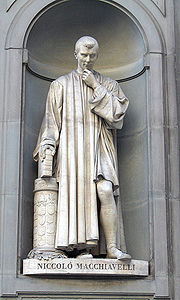
Sometime during the course of your education, many of you will be asked to read to book called The Prince. This book was written in 1513 by a man named Niccolo Machiavelli.


Machiavelli is thought to be one of the first people to write about what is now known as political science.

The Prince, which was written for a man named Lorenzo de Medici, is about power; how to get it and how to keep it. The methods described in the book are considered by many to be cruel and amoral, yet it is still widely read almost 500 years after it was first written.

Machiavelli’s methods did not include bucket filling. In fact, while he believed that it was best for leaders to be both loved and feared, he also believed that most people could only be one or the other. In such a case, he wrote, it was better to be feared.

Machiavelli wrote his book in a cold, purely objective tone. It contains no emotional content or sentimentality. As a result, while the book contains some good advice, it is known primarily for supporting the belief that “the end justifies the means”.

For Machiavelli, any tool (the means) used to get or keep power (the end) was okay. That’s been interpreted to include lying, cheating, bullying, backstabbing, stealing, spying and even murder. Today, such methods are called “machinations” and people who use them are called “Machiavellian”.


Some Machiavellian historical figures:


Julius Caesar.


Napoleon.

Hitler.

While frowned upon by most people, machinations are used today by people seeking to have a power advantage over others. For example, it is said that Bill Gates,


the founder of Microsoft and one of the richest people in the world, started his company with stolen software. 


In the 1990’s Microsoft, then the biggest software company in the world, bullied other companies into using its products and took over companies which made products better than theirs. They only stopped after they were sued several times in several different countries for unfair business practices. Microsoft lost almost every suit.

If you’ve been watching this season’s Survivor, then you’ve seen machinations in action, for one of the players, Russell, is Machiavellian to the extreme.


In his first couple of days on the show, he emptied everyone’s canteen, burned some of their clothes and made alliances with several players. Making alliances are a normal tactic in this game, except that Russell made the same promise to all of the them: “I’ll take you to the final two with me”. You do the math.

On the first night Russell told all of his teammates a story of how he was in New Orleans when hurricane Katrina struck, got stranded on the roof of his house in the flood that followed and lost his dog in the process. All of his teammates felt sympathy for him.

There was only one problem:

“I’ve never been to Louisiana, let alone New Orleans,” he told the cameraman.

Whenever anyone told Russell that they didn’t trust him, he arranged to have them voted off by saying the other player “wasn’t trustworthy”.

Russell’s Machiavellian strategy has gotten him to the merge and the final 10, but he is now outnumbered by the former members of another tribe. They don’t trust him.

Many historical Machiavellian leaders met unpleasant ends. Julius Caesar was murdered. Napoleon was exiled. Hitler killed himself.

Within the tiny world of Survivor, Russell strives to be Caesar. It will be interesting to see how it plays out, for it will demonstrate how effective machinations can be in the 21st century; some 5 centuries after they were first described.

Friday, November 13, 2009

Double Dutch Holiday Classic

Teams from all over the world compete at Double Dutch. This is a contest from 2006